✦ Origins, Music and Design ✦
Vertical Road had its world premiere on 16 September 2010 at Curve in Leicester, the theatre where Akram Khan would open DESH a year later. It's a 70-minute work with no interval, made for eight dancers. Dance Magazine's Barbara Newman wrote that it was created to mark the company's tenth anniversary. It was made during residencies at Curve and at DanceEast in Ipswich, and co-produced by an international group of partners: the Abu Dhabi Authority for Culture and Heritage, Curve, Sadler's Wells, the Théâtre de la Ville in Paris, the National Arts Centre in Ottawa, and the Mercat de les Flors in Barcelona. Within a fortnight of the premiere it was at the Ruhrtriennale festival, where it played from 29 September in the Gebläsehalle of Duisburg's Landschaftspark, and then it came to Sadler's Wells in October.
Khan drew on the Sufi tradition and on the Persian poet and philosopher Rumi. The company's own page for the work prints a Rumi passage in which the speaker dies out of each state of being into the next: mineral, plant, animal, human. After that, the speaker expects to grow wings like the angels and then rise beyond them, into something beyond imagining. The Ruhrtriennale's programme text spoke of angels as universal symbols of ascension, and of a road between the earthly and the spiritual. That's the vertical road of the title. In his own note, Khan described feeling pulled towards "a strong horizontal current" where time moves at high velocity, and said he was inclined to move against it, "in search of what it might mean to be connected not just spiritually, but also vertically". The company describes the result as "a meditation on the journey from gravity to grace".
Khan brought together a cast from across Asia, Europe, and the Middle East, and they're credited with devising the material as well as performing it. A 2012 press release for the tour noted that the work saw Khan return to pure movement, leaving out the spoken text that had featured in pieces such as zero degrees. The score was commissioned from Nitin Sawhney, who had also composed for Khan's Kaash (2002) and zero degrees. Jesper Kongshaug lit the work and Kimie Nakano designed the costumes, and the set was conceived by Khan, Nakano and Kongshaug together. Ruth Little was the dramaturg.
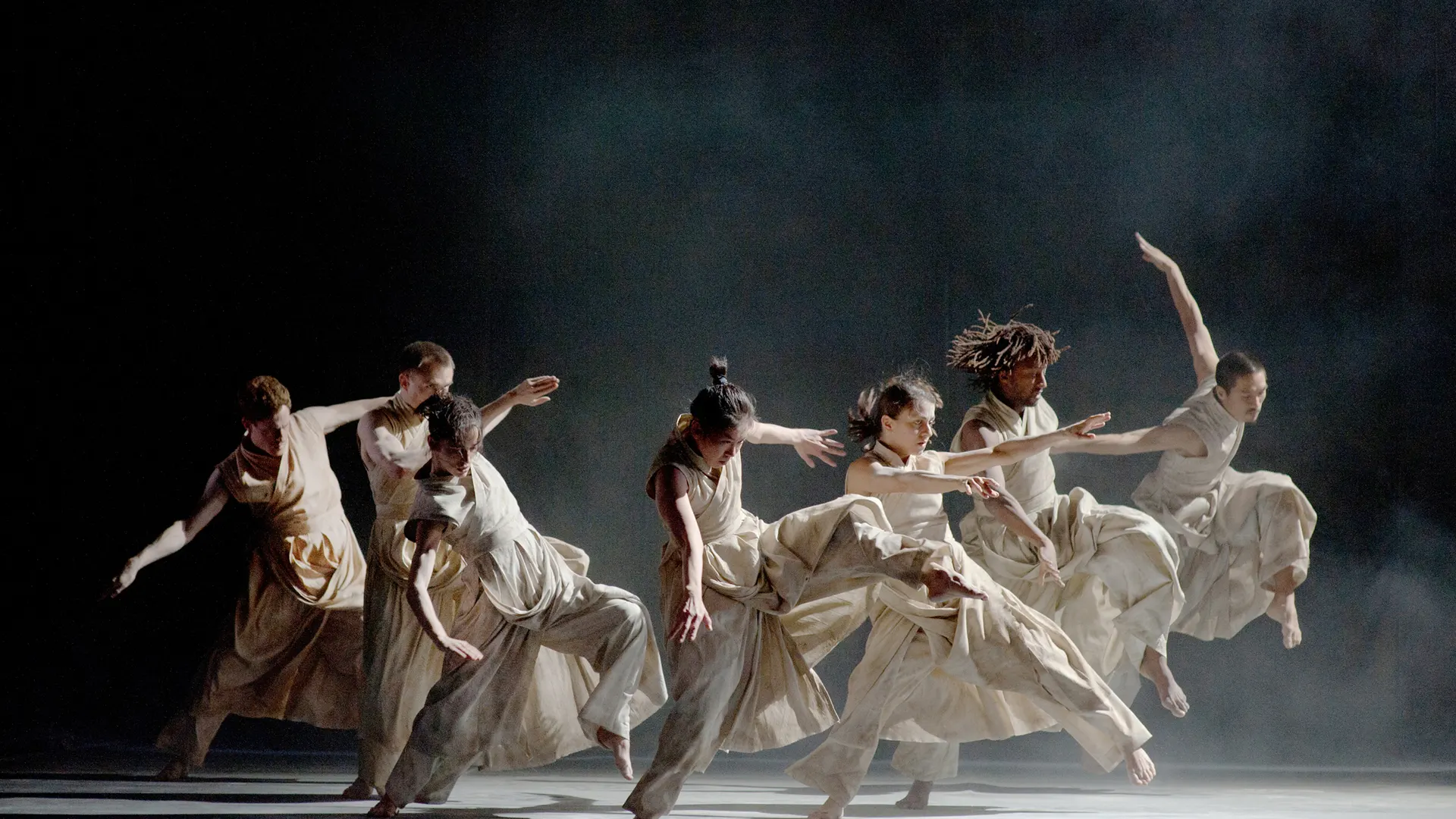
The costumes are simple, loose and pale. Vera Liber of the British Theatre Guide saw "loose stone-coloured clothes", and Alison Croggon, writing on her Melbourne blog Theatre Notes, thought the white tunics recalled "the linens of the dead, perhaps, or the robes of a Sufi devotee".
✦ On Stage ✦
Vertical Road runs straight through with no published list of sections, so what follows draws on what critics saw in London, Melbourne and New Jersey. The whole piece is built around a split in the stage: a translucent membrane stretches across it, with, in Croggon's estimate, "perhaps a third of the stage hidden behind it".
Opening: The Figure Behind the Screen
The work opens in darkness, to the sound of water, on a single man behind that screen. Liber heard "the sound of running water", and Jowitt heard distant dripping. Reviewers describe his blows sending ripples across the surface. Jowitt noticed that wherever his hands, his "scribbling finger" or his head pressed against the membrane, that part of him came into sharp focus while the rest stayed blurred. Then there's a blackout, and the sound of wind. Croggon noticed that when the lights came back the membrane had gone opaque, which she read as being cut off from the divine.
The Dust Rises
The ensemble of seven appears on the other side, folded or crumpled on the floor. Jowitt described the soloist, Salah El Brogy, picking one man up "as if he were a mannequin in a department store". The lone figure sets a clock ticking and lays out a row of seven small black tablets, which The Arts Desk's Ismene Brown likened to tombstones. Newman heard "the quiet tick of a metronome" grow steadily into "a pounding roar of drums". When the seven begin to move, dust flies off them in clouds, and Brown saw it as the dust of long-buried people being shaken off. She described "a frightening martial routine of jabbed elbows and swift evasive feints", each arm ending in kathak fingers "like handfuls of blades". Jowitt remembered a loud "clack!" as El Brogy knocked the line of tablets over in a single swipe.
The Journey: Groups, Duets and Whirling
The group movement draws on kathak and martial arts. You get stamping, beating the body, fighting, crawling, and whirling in a way the British Theatre Guide likened to dervishes. Newman found the dancers "mostly moving in perfect unison", shifting from a wedge to lines to a circle, and once passing a phrase "from body to body". Jowitt saw them "always" in touch with the ground, squatting, lunging and rolling, with jumps that "acknowledge the inevitable descent".
Smaller scenes break out of the group. Newman described a short battle between two men who seldom touch, and Jowitt named them as Sung Hoon Kim and Elias Lazaridis. A man holds a woman by the neck and the back of her tunic and flings her around "like a rag doll", in Newman's words. A slower passage to plucked strings brings a couple rolling on the floor, which Newman saw in slow motion, "always remaining at arms' length".
Ending: Back to the Membrane
The ending goes back to the membrane. Now the lone man is on our side and the others are behind it; Liber saw "shadowy spectres" with hands reaching across the divide. Croggon described a final scene in which the man left alone "wriggles and turns as if his shoulders are itching, as if he is sprouting wings". Liber saw water stream down the membrane. Jowitt described the lights turning rosy, and heard the music turn "sweet, hymnlike" at the close. The lone man grabs the membrane and pulls it down, the lights turn "almost unbearably bright", and then the stage goes black. Brown, at Sadler's Wells, remembered it differently, as "an apotheosis of explosions, lightning and enlightenment" before the lone man walks off alone.
The Sound and the Light
Sawhney's score moves between a din of electronic beats and quieter passages of plucked strings. It opens with the sound of distant dripping, and Newman also heard "gentle passages for solo piano". Brown admired Kongshaug's "wizard, arctic lighting" and its diagonal beams.
The Dancers
There are no named characters, just one figure set apart and a group of seven. The cast that toured in 2010 was Salah El Brogy, Ahmed Khemis, Eulalia Ayguade Farro, Andrej Petrovic, Young Jin Kim, Paul Zivkovich, Konstandina Efthymiadou and Yen-Ching Lin. Australian Stage counted five men and three women, from countries "as diverse as South Korea, Australia and Tunisia". El Brogy danced the lone figure.
Because the dancers devised the material, it's built from their own training as much as from Khan's. That shows in the way critics single out individuals: Jowitt picked out a duet for Ayguade Farro and Petrovic, a slow solo by Lin, and Khemis "standing still for what seems an eternity". The company's credits list thirteen dancers who have performed it across successive casts, and Petrovic went on to become its rehearsal director.
Choreographic Elements
Down Into the Floor
The title promises upward movement, but Khan's dance language is rooted in the ground. Kathak's power is in stamped footwork, and the ensemble here spends a lot of its time low, crawling, rolling and throwing up dust. See weight and grounding and floorwork.
Turning as Ascent
Ascent in this work isn't shown through lifts or jumps, which is the usual way Western theatre dance suggests transcendence. It's shown through turning. Spinning is native to kathak, and whirling is the best-known image of Sufi devotion, so it's where Khan's tradition and his source material meet.
Unison and Canon
Much of the group dancing is in tight unison, and Australian Stage saw energy rippling "from body to body in a sharp canon". The seven often read as one body, which makes the moments when someone breaks away stand out. See unison and canon.
A Wall Between Worlds
The membrane turns a vertical journey into a horizontal border, so crossing from one state of being to another becomes something you can actually see. Light makes it clear, blurred or opaque, and at the end it comes down.
Impact and Legacy
Critics admired the images but were split on the rest. Reviewing Sadler's Wells for The Arts Desk, Ismene Brown found the first half "refreshingly angry and direct", with finely drawn kathak hands. But she found the electronic score overwhelmingly loud and the arc of spiritual self-discovery predictable, and saw "a large border of pretentiousness" along the road. Vera Liber of the British Theatre Guide was more admiring. She found the work beautiful and close to hypnotic, while leaving its meaning for the viewer to build, and compared its enigmatic quality to Tarkovsky. Newman felt the vocabulary "repeats almost obsessively without developing". In Melbourne, Australian Stage called it "a very special work indeed". When it reached the United States in February 2012, at Montclair State University in New Jersey, Deborah Jowitt praised the opening and the ending but felt the sense of a spiritual journey slackened in the middle.
The tour's 2012 press release says it won the Critics' Circle National Dance Award for Best Modern Choreography in 2011. The piece toured internationally for some years, from Melbourne to Antwerp. In 2012 its only UK performance was at the Hawth in Crawley on 23 February. The work has also lived on with other dancers. Boston Ballet, the first American company to dance it, opened its 60th season with it on 5 October 2023. The Akram Khan Company says it was the first time the piece had been restaged on a professional company since 2017, that it "changes each time it is performed by a different company", and that Boston's cast of 13 spent over six weeks rehearsing it.
In Khan's career it comes just before DESH (2011), and the two tell you a lot when you look at them side by side. Vertical Road looks outward and upward, to a shared mystical tradition and an ensemble of many nationalities. DESH turns inward, to a solo built from Khan's own father and homeland. The search for connection runs through both. The cast's mix of origins matters too. Vertical Road reaches beyond the South Asian identity that shapes much of Khan's work, towards a Persian mystical tradition shared across many cultures. It's less about where Khan comes from and more a search for common ground.
How to Watch It
As of November 2026, there's no complete home recording of Vertical Road that we could find or confirm, so it's on our watch-at-home guide's "live only" list. To see it you'll need a theatre. It has been restaged on other companies (Boston Ballet in 2023 was the most recent we could confirm), so it's worth watching the Akram Khan Company's productions page and the seasons of companies that take on his work.
In the meantime, Numeridanse, the free dance video library, has Six Seasons, a 51-minute documentary about the making of DESH, and Marquee TV has Deborah May's film of zero degrees, also scored by Sawhney.
See Also
If you'd like to know more, have a read of our full profile of choreographer Akram Khan, and our profiles of his zero degrees, DESH, and Xenos. For more ensemble work rooted in stamping and the floor, try Hofesh Shechter's Political Mother.
Sources & Further Reading
- Vertical Road - production page and credits, Akram Khan Company
- Vertical Road - 2010 programme archive, Ruhrtriennale (2010)
- Vertical Road, Sadler's Wells and touring (review), British Theatre Guide (2010)
- Jonathan Burrows & Matteo Fargion, Cow Piece / Akram Khan, Vertical Road, Sadler's Wells (review), The Arts Desk (2010)
- Traveling the upward path, ArtsJournal (DanceBeat) (2012)
- Kaash - production page and credits, Akram Khan Company
- Reviews (Vertical Road, Sadler's Wells, reviewed by Barbara Newman), Dance Magazine (2010)
- Vertical Road | Akram Khan Company (review), Australian Stage (2010)
- MIAF Diary #6: Vertical Road, Theatre Notes (Alison Croggon) (2010)
- Award-winning show Vertical Road by acclaimed choreographer Akram Khan returns to the UK for one night only (press release), Kallaway via Cision (2012)
- Vertical Road (Reimagined) - Boston Ballet, Akram Khan Company (2023)
- Six seasons (documentary on DESH), Numeridanse
- About Numeridanse, Numeridanse / Maison de la Danse
- Zero Degrees, Marquee TV
Spotted an error or an out-of-date detail? Get in touch - corrections are always welcome.